GDPR for Appointment Businesses: A Practical Checklist
> General information, not legal advice — as of November 2026. Data protection depends on your country, your profession and how you work. Check with a lawyer or your data protection authority if you are unsure.
Every booking holds personal data: a name, a phone number, an email address, sometimes a note about an allergy or an injury. That makes GDPR for appointment booking a practical, everyday topic for salons, studios, therapists and service businesses, not just a legal one. This checklist explains what data a booking holds, which lawful basis you can rely on, what your privacy notice needs, how to handle marketing emails, how long to keep data and how to choose your software providers.
We refer to the General Data Protection Regulation (EU) 2016/679 throughout. The UK has its own version, the UK GDPR, which follows the same principles; the ICO publishes guidance for small businesses there.
What personal data a booking holds
Start by listing what you actually collect. For a typical appointment business, that is:
- Contact details: name, email, phone number.
- Booking details: service, date, time, staff member, price paid.
- Payment details: usually handled by your payment provider, but you keep records of what was paid.
- Notes: preferences ("prefers a quiet appointment"), history ("colour 6.1 with 20 vol").
- Health information: allergies, injuries, pregnancy, medical conditions. This is special category data under Article 9 GDPR and needs extra care.
- Communications: reminders, confirmations, marketing emails.
The first GDPR principle is data minimisation (Article 5): collect what you need for the purpose, and no more. If you do not use a client's date of birth, do not ask for it.
Lawful basis: contract vs consent
Under Article 6 GDPR you need a lawful basis for each thing you do with personal data. For appointment businesses, three bases cover most situations:
- Contract (Art. 6(1)(b)): you need a client's name and contact details to take and manage their booking. You do not need separate consent for this.
- Legal obligation (Art. 6(1)(c)): keeping invoices and payment records because tax law requires it.
- Consent (Art. 6(1)(a)): for things that are optional, such as marketing newsletters.
A common mistake is asking for consent for everything. If you rely on consent for booking reminders, a client could withdraw it and you could no longer remind them about their own appointment. Reminders about a booking the client made are part of delivering the service.
Health data is different. Because it is special category data, you also need one of the conditions in Article 9. For many practitioners that is explicit consent; regulated health professionals may rely on other conditions. We cover this in detail in our guide to health data and GDPR for therapists.
A privacy notice on your booking page
Article 13 GDPR says you must tell people, at the time you collect their data, what you do with it. On a booking page, that means a short link to your privacy notice next to the booking form.
Your privacy notice should explain, in plain language:
- who you are and how to contact you;
- what data you collect and why;
- your lawful basis for each purpose;
- who you share data with (for example your booking software and payment provider);
- how long you keep it;
- the client's rights: access, correction, deletion, objection and complaint to a supervisory authority.
Keep it readable. A one-page notice that clients can understand is better than five pages nobody reads.
Marketing emails and consent
Marketing is where most small businesses get caught out.
- Ask separately. Marketing consent should never be a pre-ticked box or hidden in the booking terms.
- Record it. Keep a note of when and how someone agreed.
- Make leaving easy. Every marketing email needs an unsubscribe link.
- Check your national rules. Email marketing is also governed by national laws based on the ePrivacy Directive, which in some countries allow limited marketing to existing customers about similar services, with an easy opt-out. The details vary.
In BizBrew, each client profile has an Allow Email marketing consent setting. When you import clients from a spreadsheet, consent is only set if a column in your file says so, so you only carry over consent you actually have. Win-back emails only go to clients who agreed to marketing.
Retention and deletion
GDPR says you should not keep personal data for longer than you need it (Article 5(1)(e)). In practice, set a simple retention policy:
- Active clients: keep their data while they keep booking.
- Inactive clients: decide a period, such as two or three years after the last visit, after which you delete or anonymise their details.
- Financial records: keep invoices and payment records as long as tax law requires. Periods differ by country and document type, so ask your tax adviser.
- Health information: professional rules may set their own retention periods.
Clients also have rights you must respond to, normally within one month:
- Access (Art. 15): a copy of their data.
- Erasure (Art. 17): deletion, unless you have a reason to keep certain records.
BizBrew has an Export client data button on each client profile for access requests, and an Erase client action that permanently removes name, contact details, notes, custom fields, signatures and message history, while keeping bookings, invoices and payments without the personal details. That helps you delete what you should and keep what the tax office needs.
Processors, DPAs and EU hosting
Your booking software, payment provider and email service process data on your behalf. Under GDPR they are processors, and Article 28 requires a written data processing agreement (DPA) with each one.
When you choose a provider, ask:
- Do you offer a DPA? It should be easy to find and sign.
- Where is the data hosted? Hosting in the EU keeps things simpler; transfers outside the EU need extra safeguards.
- Which subprocessors do you use? A good provider publishes a list.
- Who can see my data? Look for role-based access, so staff only see what their job needs.
- How do I get my data out? You should be able to export your clients and bookings at any time.
BizBrew is operated by a German company with hosting in the EU. Our DPA and subprocessor list are published on our website. Each business's data is kept separate, and role-based access controls what each team member can see. Our guide on how to choose a business management platform has more questions to ask any provider.
Staff, devices and everyday habits
Most data protection problems in small businesses are not about software. They are about everyday habits:
- Shared logins. Give every team member their own login, so you can control what each person sees and remove access when someone leaves.
- Open screens. A booking calendar left open on a front-desk tablet can show client names and notes to anyone waiting.
- Personal phones. Client details in a stylist's private messaging app are hard to control and hard to delete.
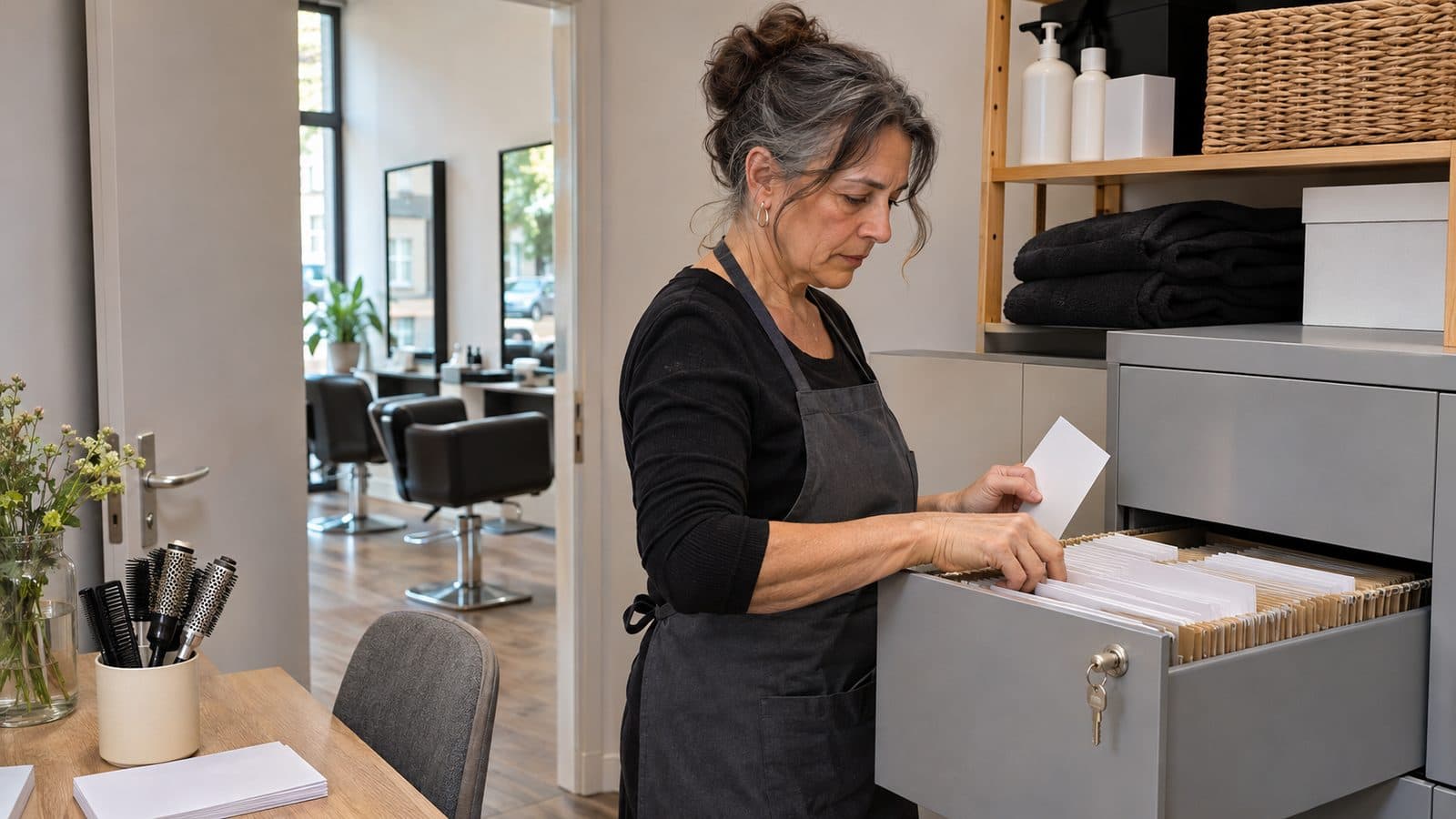
- Paper. Old consultation cards in an unlocked drawer count as personal data too.
A short team briefing once a year, plus a reminder when someone new starts, goes a long way.
GDPR for appointment booking: a checklist (general information only)
Use this as a starting point, not as legal advice:
- [ ] I have listed what personal data my bookings collect.
- [ ] I only collect what I need for each purpose.
- [ ] I know my lawful basis for each purpose (contract, legal obligation, consent).
- [ ] Health information has an Article 9 condition and limited access.
- [ ] My booking page links to a clear privacy notice.
- [ ] Marketing consent is separate, recorded and easy to withdraw.
- [ ] I have a retention policy and I follow it.
- [ ] I know how to answer access and erasure requests within one month.
- [ ] I have a DPA with every provider that processes client data.
- [ ] Staff only see the data their role needs.
- [ ] I know what to do after a data breach (Article 33 sets a 72-hour deadline to notify the authority in many cases).
FAQ
Do I need consent to send booking reminders?
Usually not. Reminders about an appointment the client booked are part of delivering the service. Marketing messages are different and usually need consent.
Can I keep client notes forever?
No. Set a retention period based on how long you genuinely need them, and check whether your profession has its own rules.
Is my booking software responsible for GDPR?
Partly. Your provider is responsible for processing data securely on your behalf. You remain responsible for deciding what you collect, why and for how long.
What if a client asks me to delete everything?
Delete what you can, and keep only what the law requires, such as invoices, without unnecessary personal details.
How BizBrew helps
BizBrew keeps client records, bookings and consent settings in one place, hosted in the EU, with role-based access, data export and client erasure built in. It works for salons and spas, therapy practices and other appointment businesses.
To see how it fits your business, start your 2 free months.